
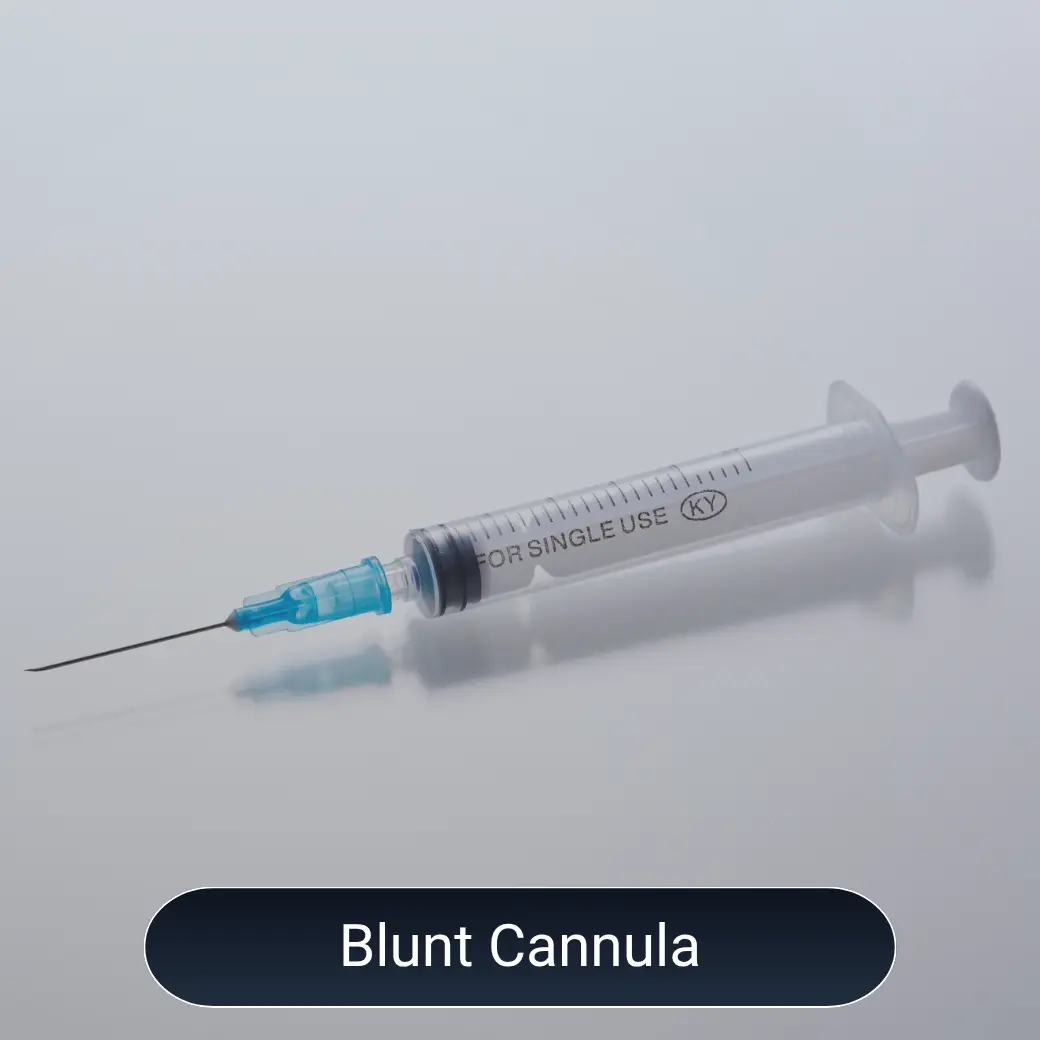
The blunt cannula is an advanced injection tool developed to enhance safety and minimize side effects compared to traditional sharp needles. Its rounded tip allows doctors to navigate smoothly beneath the skin without damaging blood vessels or surrounding tissues.
This modern technique has become increasingly popular in aesthetic medicine because it reduces pain, bruising, and swelling after filler treatments while achieving smoother, more natural results. This article explores what a blunt cannula is, why expert injectors prefer it, and which facial areas benefit most from this safer approach.
A blunt cannula is a special type of injection needle with a rounded tip instead of a sharp point. It is designed to minimize damage to tissues and blood vessels during aesthetic procedures such as filler or contour injections.
The smooth, rounded tip allows the cannula to glide gently under the skin without piercing blood vessels, reducing the risk of bruising, swelling, or vascular complications. In contrast, sharp needles penetrate tissue directly, which may increase the chance of bleeding or blockage.
In aesthetic medicine, blunt cannulas are widely recognized as a safer and more precise tool for filler injections — especially in delicate areas like under the eyes, nasolabial folds, and temples — where control and precision are critical for natural-looking results.
Expert injectors prefer using blunt cannulas because they offer greater control and precision in placing fillers, while significantly reducing pressure and trauma to surrounding tissues. This minimizes post-treatment bruising and swelling compared to sharp needles.
A blunt cannula allows the injector to navigate smoothly beneath the skin without puncturing blood vessels or nerves — a key factor in safety, especially in delicate areas such as under the eyes, temples, and tear troughs, where vascular occlusion can occur with sharp needles.
Moreover, blunt cannulas promote even filler distribution, creating smoother, more natural-looking results and reducing the risk of lumps. That’s why experienced doctors worldwide — including those at Smooth Clinic — choose this technique to ensure both safety and optimal aesthetic outcomes for every patient.
One major reason blunt cannulas are widely used is their ability to minimize discomfort and speed up recovery. With a rounded tip that glides through tissue instead of piercing it, the cannula causes less trauma to the skin and blood vessels during filler injections.
Because it doesn’t cut through blood vessels, the chance of bruising or swelling is significantly lower — especially in delicate areas like under the eyes, temples, and tear troughs, where vascular density is high. This allows doctors to inject more safely and precisely.
Both clinical experience and patient feedback confirm that treatments performed with blunt cannulas typically result in less pain, minimal swelling, and faster recovery — making this technique a preferred choice among professional aesthetic clinics.
Blunt cannulas significantly enhance the safety of filler injections. Their rounded tips do not puncture blood vessels, thereby reducing the risk of vascular occlusion, one of the most concerning complications associated with sharp needles.
Because doctors can control the direction of a blunt cannula precisely, fillers can be placed evenly and within the proper skin layer. This minimizes the risk of lump formation, uneven texture, and excessive pressure on surrounding tissues — resulting in less swelling after treatment.
Several medical studies (e.g., Dermatologic Surgery Journal, 2022) have confirmed that blunt cannulas lower the incidence of bruising, swelling, and infection. As a result, they have become the preferred standard for safety-focused aesthetic clinics such as Smooth Clinic.
Blunt cannulas are ideal for areas with dense networks of blood vessels and nerves, such as under the eyes, tear troughs, temples, cheeks, and nasolabial folds. Their rounded tips help avoid piercing blood vessels, effectively reducing the risk of bruising or vascular blockage.
For delicate zones like the under-eye area, doctors often use shorter, finer cannulas to ensure smooth filler placement and precise depth control. In contrast, larger or longer cannulas are chosen for broader regions like the cheeks or jawline to achieve even, natural contouring.
Each patient’s facial structure and skin thickness are carefully assessed before injection. This allows physicians to select the optimal cannula gauge and length, ensuring natural-looking results with maximum safety — the standard practiced at Smooth Clinic.
The filler injection process with a blunt cannula begins with a facial assessment to identify target areas and appropriate skin layers. The skin is then cleansed, and topical anesthesia is applied to minimize discomfort.
A small entry point is made using a fine sharp needle, through which the blunt cannula is gently inserted. This rounded cannula glides smoothly beneath the skin, avoiding blood vessels and reducing tissue trauma, allowing for precise and even filler placement.
After the filler is evenly distributed, the doctor gently massages the treated areas to refine shape and symmetry. The entire procedure typically takes around 30–45 minutes, and patients can resume normal activities immediately with minimal downtime.
Although both tools are used for filler injections, their structures and outcomes differ significantly. The choice depends on the injection site and the doctor’s technique to balance precision and safety.
| Comparison Point | Sharp Needle | Blunt Cannula |
|---|---|---|
| Tip Design | Sharp, penetrates tissue directly | Rounded, glides smoothly through tissue |
| Tissue Trauma | Higher chance of bruising or bleeding | Minimal trauma, less bruising and swelling |
| Filler Distribution | Suitable for precise, small areas | Allows even, natural filler spread |
| Best for Areas | Lips, nose tip, small correction zones | Under eyes, cheeks, temples, nasolabial folds |
| Overall Safety | Higher vascular risk | Safer under expert supervision |
| Clinical Use | For entry points or fine detailing | For main filler delivery and contouring |
In professional practice, both types are often combined — a sharp needle creates the entry point, while a blunt cannula distributes filler smoothly and safely.
The blunt cannula represents a new standard in filler injection safety and precision. It allows physicians to deliver fillers with greater control, minimizing the risks of vascular complications and ensuring smoother, more natural-looking outcomes.
Choosing a clinic that employs advanced cannula techniques under expert medical supervision — such as Smooth Clinic — ensures that every treatment prioritizes safety, balance, and beauty tailored to your unique facial structure.
Results may vary from person to person. A professional consultation is always recommended for personalized advice.
Pain is usually minimal because the rounded tip doesn’t pierce blood vessels directly. Topical anesthetic is typically applied, so patients only feel mild pressure or tightness.
They’re ideal for high-risk vascular areas like under the eyes, cheeks, temples, and tear troughs. However, sharp needles may still be preferred for precise spots such as the lips or nose tip.
Yes. Since they don’t cut through blood vessels, the risk of bruising and swelling is significantly lower, leading to faster recovery compared with sharp-needle injections.
The duration is similar, though cannula injections require more skill and attention from the doctor to ensure even filler placement and smooth contouring.
Patients can resume normal activities immediately. Avoid pressing or massaging the treated area for the first 24 hours, and follow your doctor’s instructions for the best results.

Medical Reviewer: Dr. Chaiwat Songsiriphan
COOLSCULPTING KOL [KEY OPINION LEADER]
• M.D., Chiang Mai University
• Cert. Laser and Aesthetic Skin Therapy (Harvard Medical School 2016)
• Cert. CoolSculpting University Seoul 2017
• Cert. Filler Injection Allergan Medical Institute
Over 10 years of experience in Aesthetic Dermatology
Latest Article Update: April 26, 2026


