
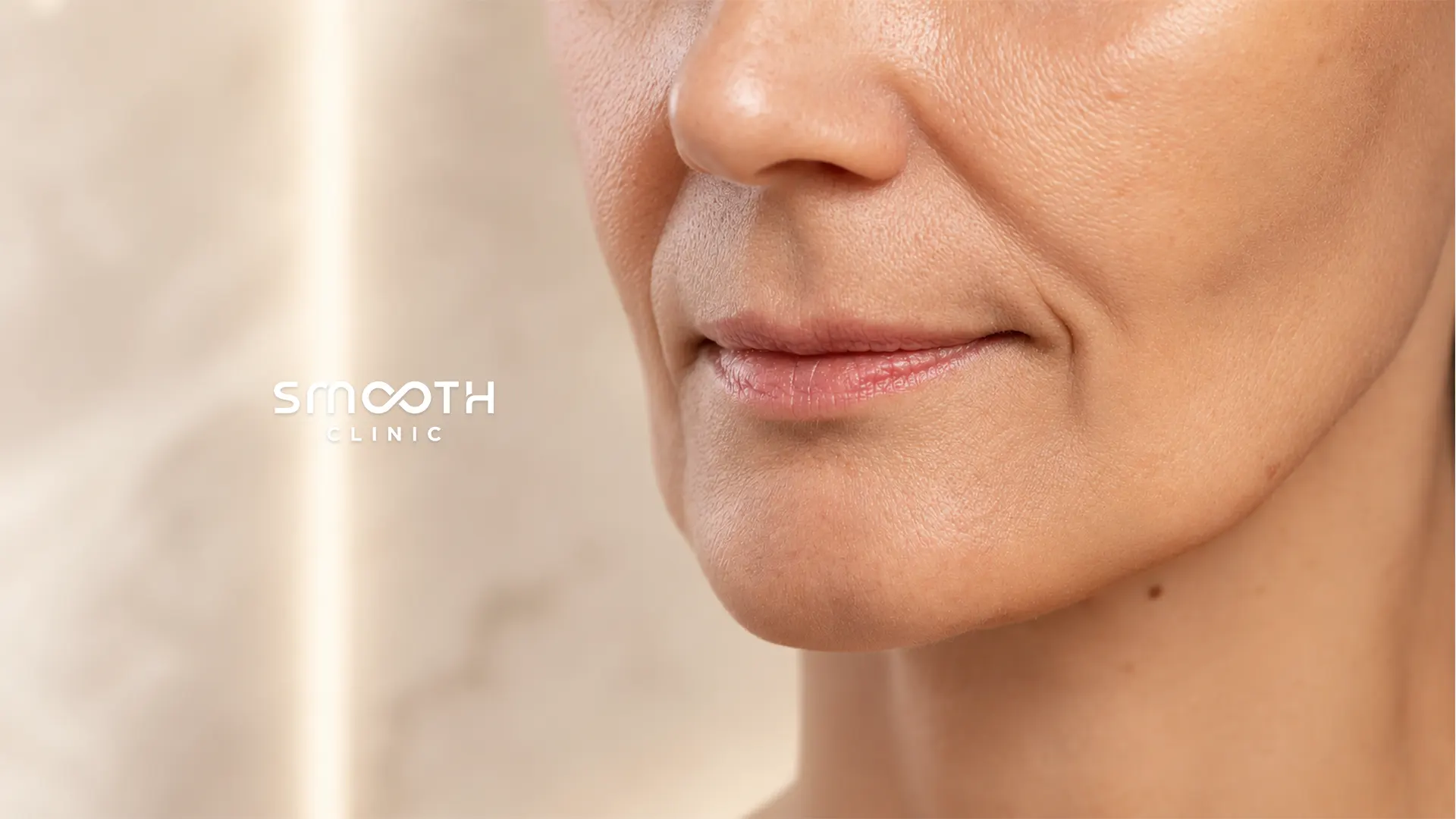
What causes nasolabial folds?
Nasolabial folds reflect the shape and movement of the whole midface, not just a crease in the skin. Several factors affect how noticeable they are:
- Natural facial structure: Bone shape, cheek fat and the way tissues attach around the mouth help explain why some people have visible folds when they are young.
- Aging: Changes in bone support, facial fat and skin elasticity can make folds more pronounced.
- Facial expression: Folds often deepen when you smile. This is normal movement, not a reason to stop smiling.
- Skin and weight changes: Sun exposure and smoking contribute to skin aging. Significant weight loss can also change facial fullness.
Men and women can both have noticeable folds. Individual anatomy matters more than broad assumptions about gender or age. Cheek hollowing, under-eye changes or sagging facial skin may need separate assessment.
Do deep smile lines need treatment?
No. Nasolabial folds are a normal facial feature. Treatment is optional, and the aim is usually to soften a concern rather than erase every fold or change how you smile.
If they bother you, a doctor should assess your face at rest and during expression, including cheek support, skin laxity and any previous treatment. A shallow, moderate or deep label alone cannot determine which procedure or amount of filler is appropriate.
What can skincare and everyday habits do?
- Protect your skin from the sun: Use a broad-spectrum, water-resistant sunscreen with SPF 30 or higher, alongside shade and protective clothing.
- Moisturise: Hydration can temporarily make fine surface lines less noticeable. Creams cannot replace lost facial volume or lift a deep fold.
- Avoid smoking and harsh skincare: These changes support skin health without promising to remove existing folds.
Facial massage and exercises are not established treatments for deep nasolabial folds. A small facial-exercise study found improved cheek fullness but no significant improvement in folds at rest. Follow your treating doctor’s advice about massage after any procedure.
How do the treatment options differ?
The useful question is whether the main issue is volume loss, laxity, surface skin changes or a combination. No single treatment is best for every face.
Hyaluronic acid filler: adding volume
Hyaluronic acid (HA) filler can soften selected folds by adding volume. A doctor needs to consider the surrounding support as well as the line itself; more filler is not automatically better.
Changes may be visible soon after injection, but swelling can affect the early appearance. Results are temporary. Bruising, tenderness, lumps and infection are possible, and filler carries the serious vascular risks described below.
Focused ultrasound: addressing some skin laxity
Focused ultrasound uses energy to heat tissue and may produce gradual tightening. It does not replace lost facial volume, and a visible fold alone does not establish that you are a suitable candidate.
Devices are not interchangeable. For example, Ultherapy PRIME’s U.S. instructions list pain, swelling, bruising, burns and nerve effects. Its U.S. indications do not include a specific nasolabial-fold claim and do not establish Thai indications or those of Ultraformer III.
Radiofrequency (RF) uses a different form of energy. Our HIFU and RF comparison explains the distinction and why the exact device matters.
Collagen-stimulating injectables: product-specific treatment
Some injectables, such as poly-L-lactic acid (PLLA), encourage collagen formation and produce gradual changes. They are not interchangeable with HA filler or with one another. Suitability, treatment course and duration depend on the product and its approved use.
Swelling, bruising and delayed lumps or inflammation can occur. These products should not be presented as universally longer-lasting, safer or more suitable for deep folds than HA filler.
If there is substantial loose skin, nonsurgical options may offer limited improvement. A doctor can discuss other approaches; combining several procedures is not automatically necessary.
What should you check before treatment in Thailand?
- Choose a licensed clinic and a doctor experienced with the proposed treatment, with a clear plan for complications and follow-up.
- Ask for the exact product or device model and its Thai registration and intended use. Overseas approval does not establish approval in Thailand.
- Discuss realistic improvement, discomfort, recovery, when to assess the result and whether further treatment may be needed.
- Request the total price for your individual plan, including the product, amount or treatment area, sessions and follow-up. Confirm current prices and terms before booking.
Tell the doctor about previous injections, medical conditions, allergies, medicines, pregnancy or breastfeeding. Postpone injections into an area with active inflammation or infection until it has been assessed and treated. Do not stop prescribed medicines on your own.
Before-and-after photographs can help with discussion, but another person’s result is not a promise. Compare similar lighting, angles and facial expressions.
When to get urgent help after an injection
Accidental injection into a blood vessel can cause tissue damage, skin death, vision loss or stroke. Seek immediate medical attention for unusual pain or skin that becomes pale, grey or mottled during or after treatment. Vision changes, difficulty speaking or limb weakness need emergency care; do not wait for a routine follow-up.
To discuss which concern is most relevant to your face, contact Smooth Clinic for an assessment.
References
- Swift A, et al. The Facial Aging Process From the “Inside Out”. Aesthetic Surgery Journal, 2021.
- American Academy of Dermatology. 11 ways to reduce premature skin aging.
- American Academy of Dermatology. Many ways to firm sagging skin.
- Alam M, et al. Association of Facial Exercise With the Appearance of Aging. JAMA Dermatology, 2018.
- U.S. Food and Drug Administration. Dermal Fillers (Soft Tissue Fillers).
- Merz Aesthetics. Ultherapy PRIME: U.S. Instructions for Use.
- U.S. Food and Drug Administration. A Patient’s Guide to Treatment with Sculptra. U.S. product information; not evidence of Thai approval.