
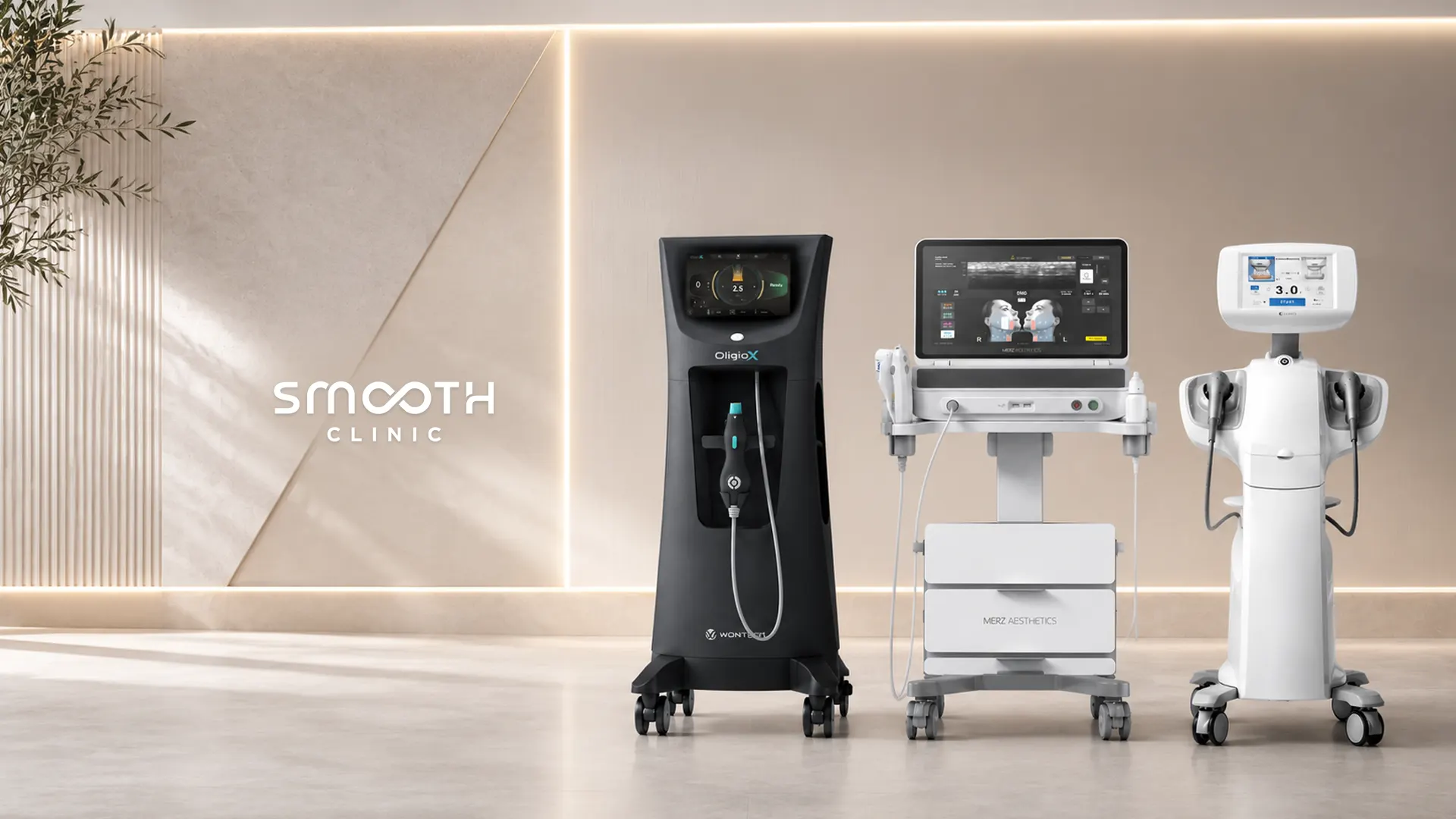
How do HIFU and RF devices differ?
HIFU is a broad term for focused-ultrasound treatments. RF skin tightening uses radiofrequency energy. The RF devices compared here work without needles; RF microneedling is a different procedure with different risks and recovery needs.
| Device | Energy type | Key distinction |
|---|---|---|
| Ultherapy PRIME | Microfocused ultrasound with visualization (MFU-V) | Real-time ultrasound imaging helps the practitioner assess tissue and skin contact. Imaging depth is different from treatment depth. |
| Ultraformer III | Micro- and macro-focused ultrasound (MMFU) | Different cartridges are selected for the treatment area and plan. Information about Ultraformer MPT does not automatically apply to III. |
| Thermage | Non-invasive monopolar RF | The FLX model has automatic energy calibration, cooling and vibration. Confirm the model and treatment tip when comparing offers. |
| Oligio X | Non-invasive monopolar RF | Uses G/X modes, cooling and monitoring of tissue resistance. It is a separate model from the original Oligio. |
| XERF | Non-invasive monopolar RF | Uses 2 and 6.78 MHz. Two frequencies describe the system; they do not establish better lifting than another device. |
These features explain how the devices work; they do not establish which is best, least painful or longest-lasting. A deeper treatment is not automatically better. The SMAS, a facial support network beneath the skin, is not at one fixed depth across the face.
Which suits your face, neck or body concern?
Start with the cause of the concern. Mild skin laxity, wrinkles, excess fat and loss of facial volume need different assessments. Non-surgical tightening may offer a modest improvement when skin is only slightly loose. It cannot reproduce a surgical facelift or remove substantial excess skin.
| Concern | What matters when choosing |
|---|---|
| Jawline or neck laxity | Ask how much improvement is realistic with the proposed device and whether another approach would better address marked sagging. |
| Double chin | Separate loose skin from fat. A skin-tightening treatment is not automatically a fat-reduction treatment, and unwanted volume loss can be a concern. |
| Brow, eyelids or eye bags | These are different treatment targets. Brow lifting does not mean a device can be used on the eyelids. Ultherapy PRIME instructions exclude the eyes, eyelids and inside the orbital rim; Thermage eye-area treatment has specific tip and eye-protection requirements. |
| Abdomen, arms or thighs | Check the exact model, applicator and intended body area. A result from facial treatment cannot establish the same result elsewhere. |
Thin or sensitive skin does not automatically make Oligio X, Thermage or any other device the right choice. The practitioner needs to assess your skin, anatomy and treatment goals.
Ultherapy PRIME vs XERF: which should you discuss with your clinician?
The main difference is how energy is delivered and treatment is planned. Ultherapy PRIME uses microfocused ultrasound with visualization; XERF uses dual-frequency monopolar RF. Your anatomy and the cause of the concern matter more than choosing a brand by age alone.
How do energy and treatment planning differ?
Ultherapy PRIME: Ultrasound imaging helps the clinician assess tissue layers and contact before delivering focused energy. This is a feature of MFU-V, not every device advertised as HIFU. The depth visible on screen is not the same as the depth treated.
XERF: A non-needle applicator delivers RF at 2 and 6.78 MHz. Heating depends on the settings, applicator and tissue. Frequency figures cannot be compared directly with an ultrasound cartridge’s treatment depth, and two frequencies do not by themselves demonstrate a better result.
What if your concern is a soft jawline, loose skin or hollow cheeks?
- Loose skin or a less-defined jawline: Ask which part of the concern comes from laxity, tissue position or fat, and what the proposed treatment can realistically change.
- Thin cheeks or facial hollowing: Have tissue thickness and volume assessed first. Tightening does not replace lost volume; either device may be a poor match if volume loss is the main issue.
- Marked sagging: Neither option should be presented as equivalent to a facelift. Discuss alternatives, including a surgical assessment when appropriate.
Do you need both, and what does the evidence show?
Combining the two is not necessary for everyone. Each treatment should have a distinct purpose that justifies its additional cost and risks. Previous procedures, tissue response and the planned areas determine sequencing; there is no universal interval for combining them.
The references reviewed here do not establish that Ultherapy PRIME is superior to XERF, or the reverse. The older RF-versus-MFU-V trial below is not a direct comparison of these two models. XERF’s FDA 510(k) submission included no clinical tests; that document does not prove superior facial-lifting results.
For device-specific information, read the Ultherapy PRIME treatment guide and XERF treatment guide.
Which works faster and lasts longer?
There is no reliable universal ranking for the devices discussed here. A small randomized split-face trial treated 20 people with mild to moderate laxity using monopolar RF on one side and MFU-V on the other. Both sides improved over six months, with no statistically significant difference in the investigators’ laxity scores. This does not prove equivalence or rank all the models discussed here.
Changes generally develop over weeks to months. Early tightness does not show the final result, and results are not permanent. Ask when to assess your outcome and whether repeat treatment is justified, rather than choosing a package solely by a promised duration or fixed yearly schedule.
If filler, botulinum toxin or another procedure is also planned, include it in the same clinical assessment rather than booking separate treatments without discussing the sequence.
What about pain, downtime and risks?
Both ultrasound and RF can feel hot or painful. Cooling and vibration may help with comfort but do not guarantee a painless treatment. Redness, swelling, tenderness or bruising can affect work and social plans, even when a treatment is advertised as having little downtime.
Burns, scars, pigment changes and altered sensation can occur. Microfocused ultrasound also has reports of nerve effects and unwanted fat or volume loss; these reports do not establish how often they happen. Risks depend on the device, treatment area and technique.
- Tell the clinician about pacemakers, other implanted devices and metal near the treatment area. Thermage CPT/FLX is contraindicated with implanted electrical devices; other systems have their own restrictions.
- Have wounds, infection or active skin disease assessed before treatment. Tell the clinician if you are pregnant or breastfeeding. Ultherapy PRIME has not been evaluated in these groups; discuss postponing elective treatment and check the requirements for the proposed device.
- Tell the clinician about medicines you use and previous filler, threads or other procedures in the area. Do not stop prescribed medicines yourself.
Follow the clinic’s aftercare instructions, use gentle skincare and protect treated skin from the sun. Ask when to restart irritating products. Seek prompt medical assessment for blistering, worsening pain, unusual skin colour changes, persistent numbness or new weakness. Vision changes need immediate assessment.
XERF has a recall notice covering specific lots of EFFECTOR 60 tips. Providers should verify tip lots; affected tips must not be used and should be returned in accordance with the recall instructions. The notice does not cover every XERF device and does not establish that Smooth Clinic holds affected stock.
How should you compare costs in Thailand?
Ask for a written quote in Thai baht for the exact model, treatment area and plan. Check whether consultation, treatment tips, pain relief and follow-up are included. A “shot” or “line” is not a standardized unit across different systems, so a larger number alone does not show better value.
Check the clinic’s licence, the treating clinician’s experience and the device’s Thai regulatory documentation. Overseas clearance does not establish authorization in Thailand. Confirm that consultation, consent and aftercare can be explained in a language you understand, and how to get help between visits.
To ask about current options and a personalized quote, contact Smooth Clinic.
Before deciding, make sure you can answer three questions: What problem are we treating? Why this device? How will the result and any concerns be followed up? If you are visiting Thailand, agree on follow-up arrangements before you leave.
References
- American Academy of Dermatology. Many ways to firm sagging skin.
- Ulthera. Ultherapy PRIME: US instructions for use. Manufacturer information.
- CLASSYS. Ultraformer III technology overview. Manufacturer information.
- Solta Medical. Thermage FLX technology and US safety information.
- WONTECH. Oligio X technology and specifications. Manufacturer information.
- Alhaddad M, et al. Randomized split-face trial comparing monopolar RF and MFU-V. Dermatol Surg. 2019;45(1):131–139. doi:10.1097/DSS.0000000000001653.
- Macchi V, et al. Anatomo-radiological study of the superficial musculo-aponeurotic system of the face. 2007.
- U.S. FDA. RF microneedling safety communication. 15 October 2025; specific to needle-based RF.
- U.S. FDA. XERF 510(k), K251327. System description and submitted evidence.
- U.S. FDA. XERF EFFECTOR 60 recall: specific tip lots. Checked 15 October 2026.